
Price Details
Price: £29,000 GBP
Location: Maldon, Essex GB
Make: Hagg
Year: 1975
Class: Power Cruisers
Description
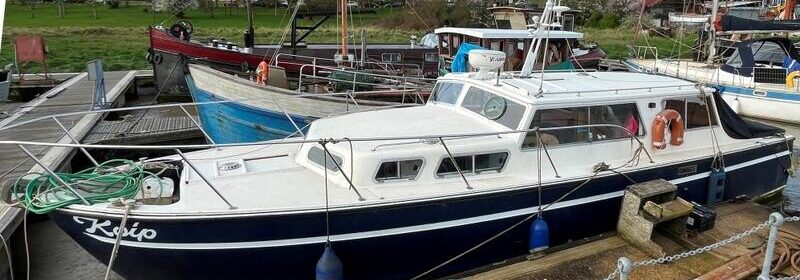
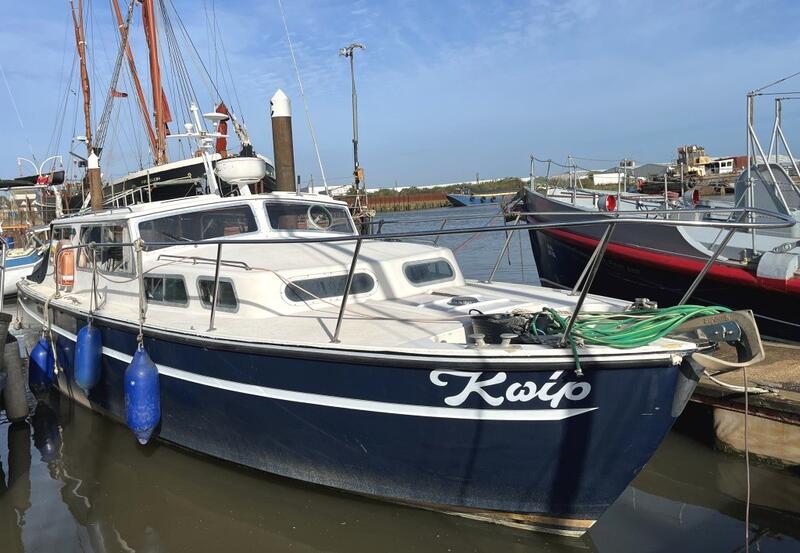
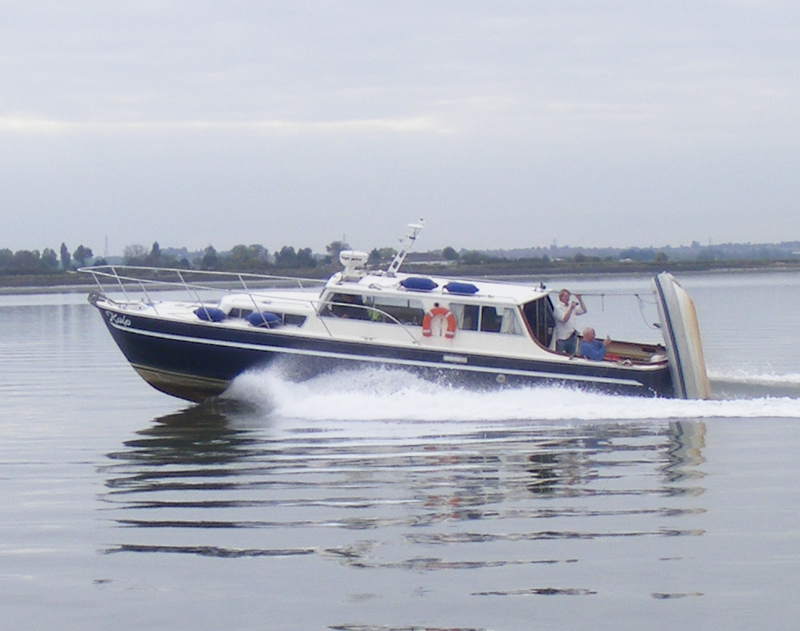
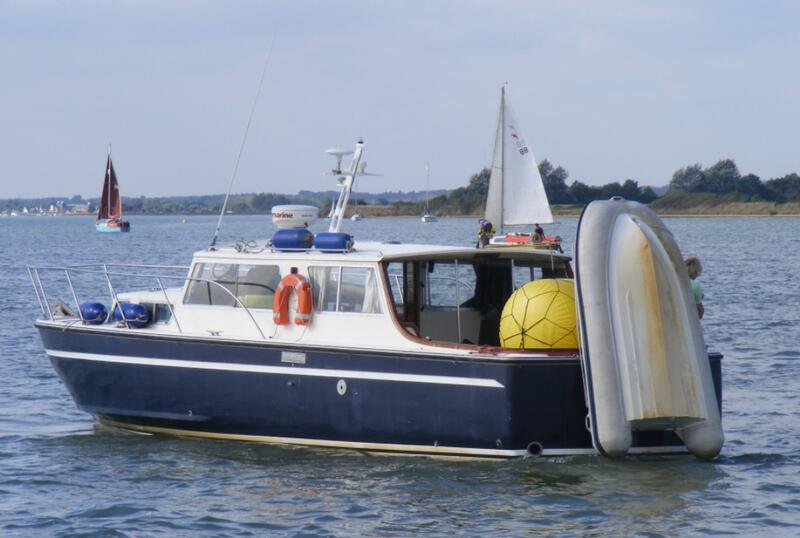
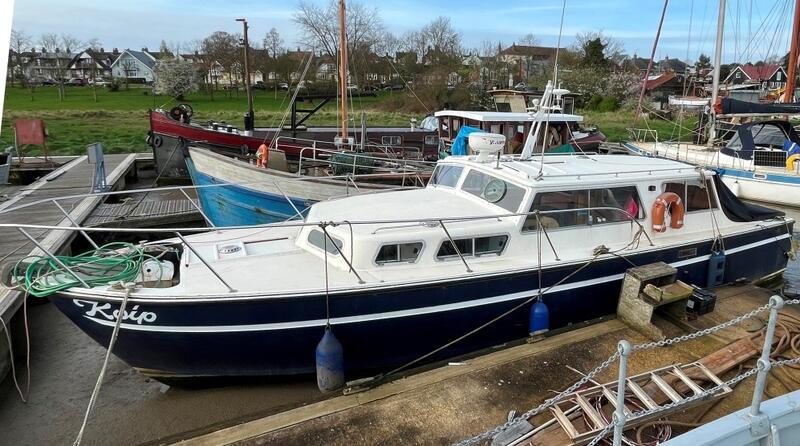
Hagg 36 motor cruiser, GRP construction by Tyler Mouldings, fitted out in 1975 by Boston Marine Ltd, Plymouth, Devon, as a fast semi displacement,
twin diesel engines for both use at sea and inland waterways, she has a very slight air draft of a 2.25m, useful on the inland waterways. maximum speed 18 knots
Cruising speed 8-10 knots.
Hull length 36′-0″ (10.97m), beam 11′-0″ (3.35 m), a draft of 3′-0″ (0.91 m) and a displacement of 10,5 tons.
Comfortable accommodation with good headroom throughout. 2-4 persons .
Internal helm position. Deep aft open cockpit with fitted tonneau cover.
Purchased 8th April 2014, last surveyed August 2023.
Length
Nominal Length: 10.97m
Length Overall: 11.20m
Length Of Deck: 10.97m
Beam: 3.25m
Draft: 1.00m
Air Draft: 2.03m
Max Draft: 1.00m
Specifications
Fuel Tank Capacity: 110 gallons x 2
Cruising Speed: 8 knots max 15-18knots
Engine Power: 175hp each
Accommodation
Berths: 6 Cabins: 2 Heads: 1 Passenger Capacity: 4
Builder/Designer
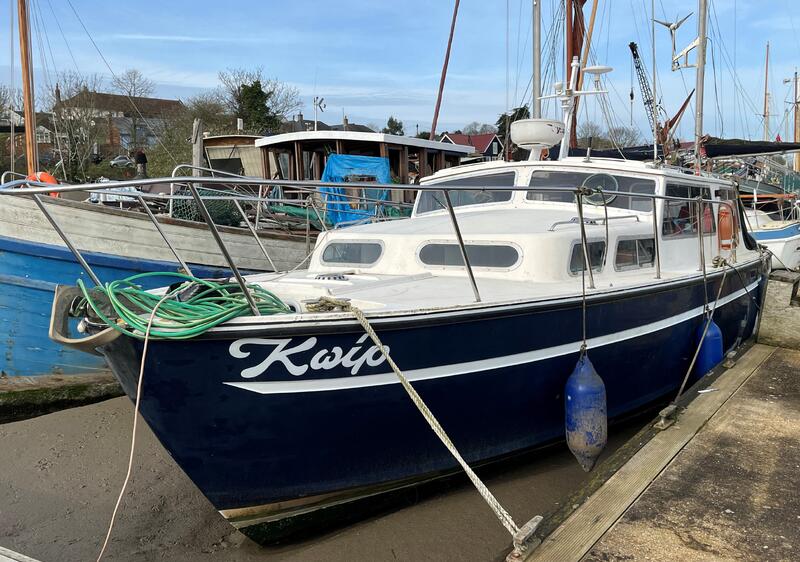
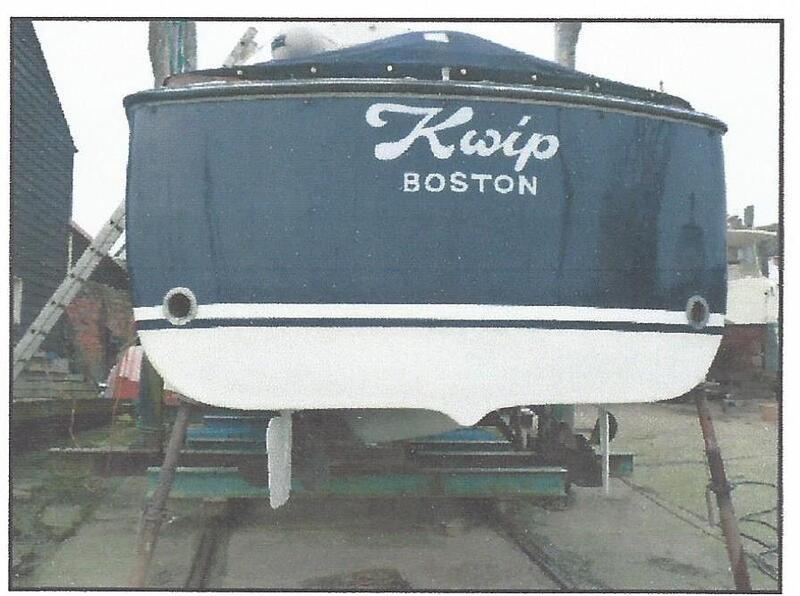
Designer: Arthur E. Hagg Boat Name: Kwip
Hull
Hull Material: Fibreglass Hull Design: Semi Displacement Hull Speed: 18 knots
Engines
Engine Description: Engines are twin Perkins 175 H.P Diesel, T6354.
They have been regularly run up and the turbo blowers exercised.
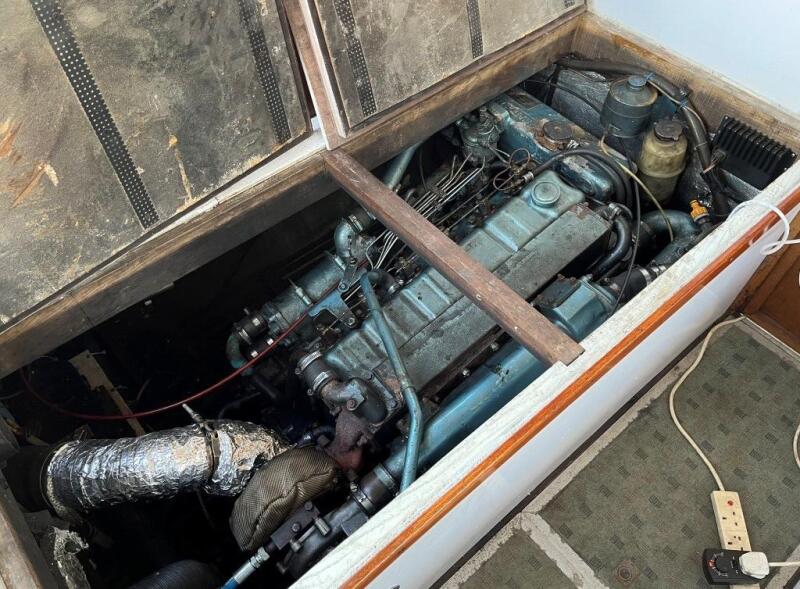
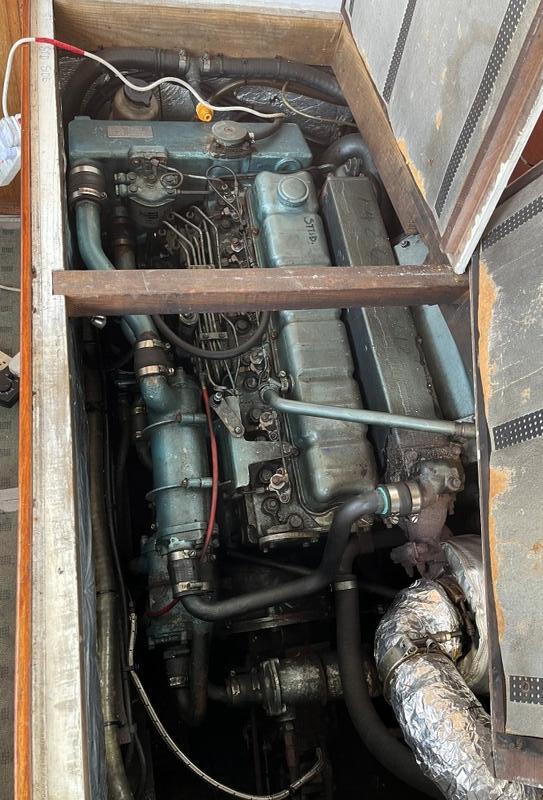
Engines are shaft driven, fresh water cooled, the exhaust manifolds are fed salt water, in order to avoid internal rusting. Provision has been made to flush the entire seawater part of the cooling system through with fresh water after any use,
either under way or after maintenance running. The port engine tends to burn a little oil the starboard virtually none. Under her present ownership, a log is available of engine hours run and fuel consumption.
Fuel tanks are 110 Gallons each, not cross connected, (port tank feeds the Webasto heater.)
Engines are enclosed by demountable soundproofed engine box which can be completely removed allowing ‘stand up’ access round both engines. Engines are freshwater cooled via heat exchangers with easily accessible filters.
Seacocks are rendered easy to open and close via Stainless extension handles
Drive is via Borg Warner Velvet Drive boxes, 2-1 reduction. Remote shaft greasers, stuffing boxes accessible through hatches in cockpit floor. Cutlass bearings at outboard ends of shafts
A large hatch in the Saloon gives access to tops of two fuel tanks including contents dipping caps. (No tank gauges fitted)
Construction:
Hagg 36, described by motor yachting journalist Alec McMullen, as “one of the most distinctive production motor cruisers ever built, a culmination of a lifetime spent creating innovative,
fast vehicles by one of the unsung forces in 20th Century aircraft and power boat design, Arthur E. Hagg.”
Hagg 36, GRP construction by Tyler Mouldings, she was fitted out in 1975 by Boston Marine Ltd, Plymouth.
From the bow , a self draining anchor stowage well, a sliding hatch, aft of the well, gives access into the fore cabin.
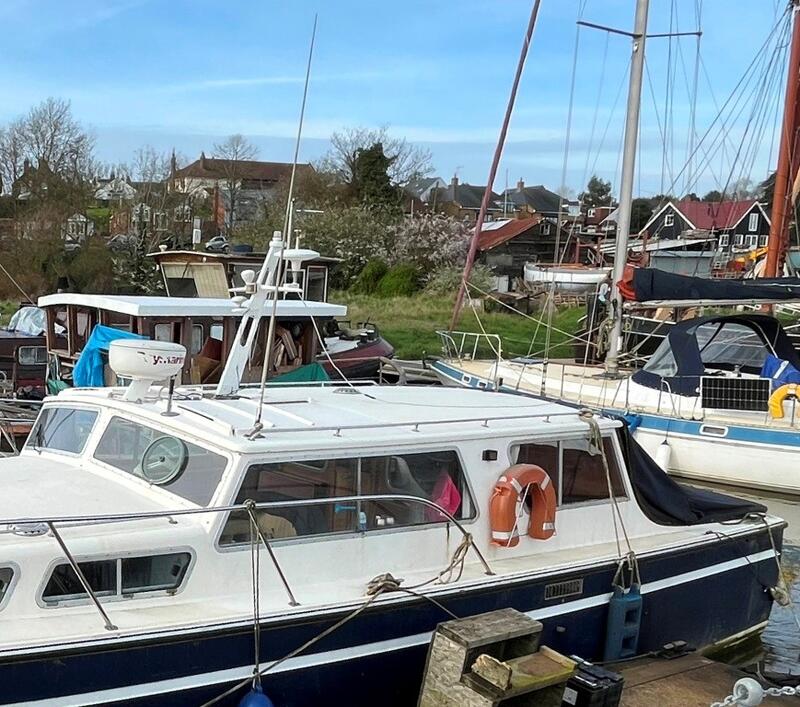
A low raised coach roof with front and side windows.
A forward windscreen of the main saloon, has one with a blade wiper, the helmsman’s side has a rotating ‘Clear View’ screen.
The main saloon coach roof supports the radar scanner and a short mast with T.V. and G.P.S. antennae.
Sliding hatches either side, one over the helmsman’s seat to port and the other to Starboard.
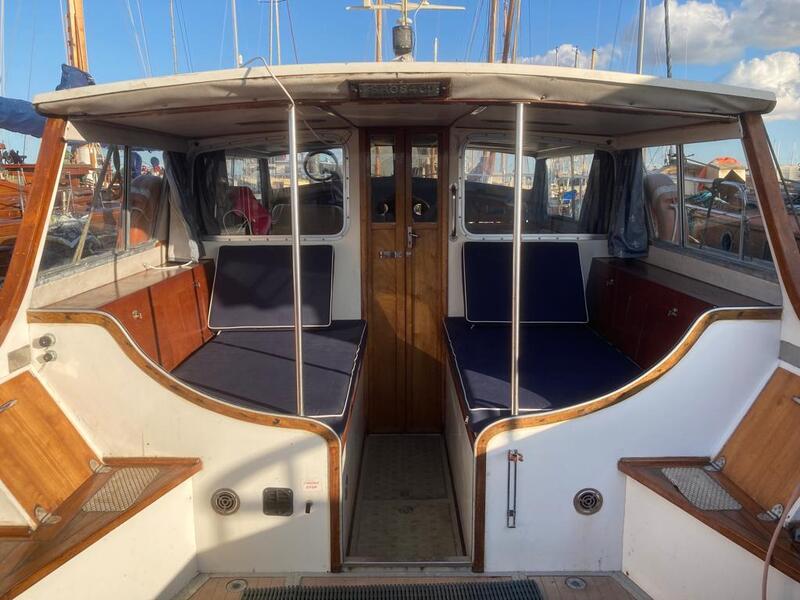
The accommodation coach roof extends aft to the rear of the engine bays, creating a shelter deck over. The engine boxes form large single day beds, with an infill they can be made into a very large double berth.
Wide side decks extend all the way aft to the transom. Amidships looking Forward a glazed bulkhead doorway, access into main deck saloon, helm position and accommodation.
A large ‘tonneau’ canvas cover when its fitted over the cockpit, it allows the space to be a used as a two-berth cabin.
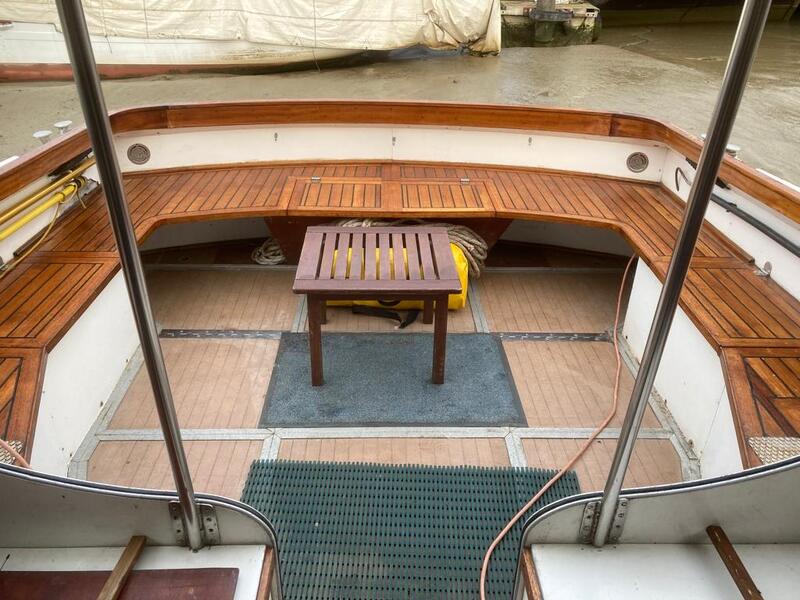
Aft is a large open cockpit has varnished comings, bench seating each side and aft and small table. Opening bench tops provide large stowage bins, access to battery isolators, stern tube greasers and a vented two bottle gas locker,
There’s also a galvanised bin locker for paints and lubricants etc. The transverse section aft lifts to access warp stowage etc.. Shore power inlet socket under port bench.
Stowage for boathook etc. under side decks. Sections of the floor lift to provide access to calorifier, water pump, F.W Tankage, stuffing boxes, steering gear/rudder stocks etc.
Accommodation:
Forward Cabin – A hatch in the coach roof allows access to the chain locker ( in forepeak). A forward facing forward window with curtaining. Either side of the cabin is a hanging locker.
A sliding hatch over the double allows access on to fore deck. A large athwartship double berth. Stowage lockers and cupboards. 12v cabin lighting and sliding opening windows. Double self-closing cabin doors.
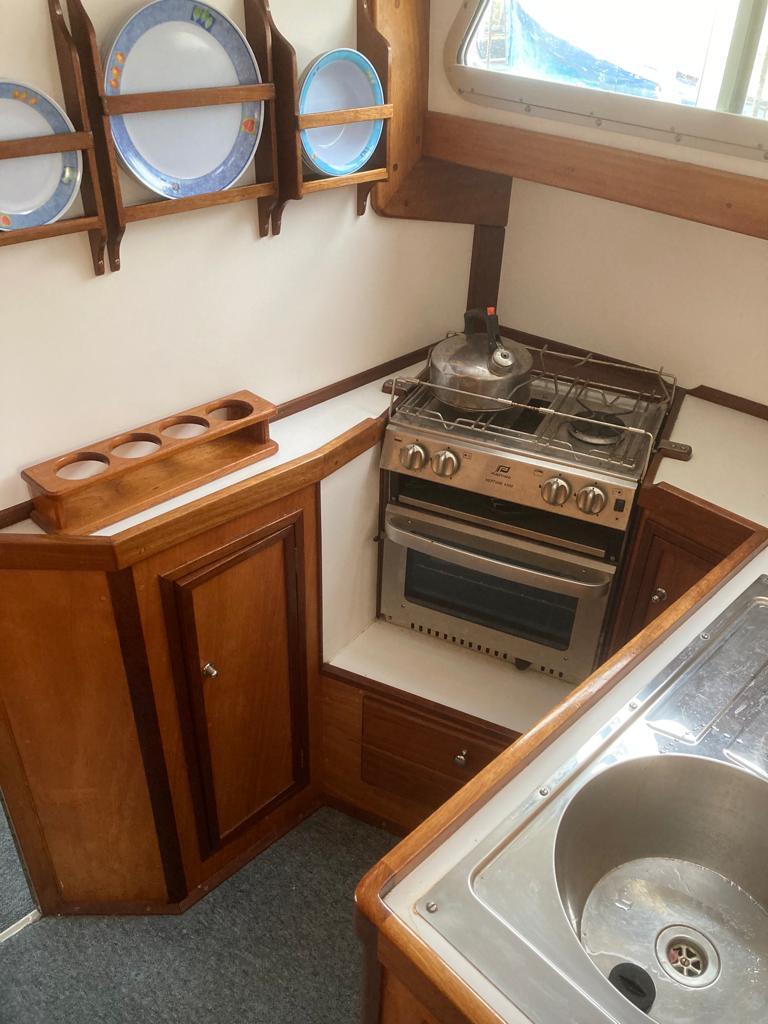
Galley – to Starboard, with a two-burner gas cooker with grill and oven. (2 x bottle gas locker in cockpit). An electric fridge. Ample stowage for utensils, crockery, cutlery and cleaning equipment.
Slide opening windows. A stainless steel sink / drainer, hot and cold pressurised water system. (water heater via main engine system, when under way, or by 240V immersion heater when on shore power.
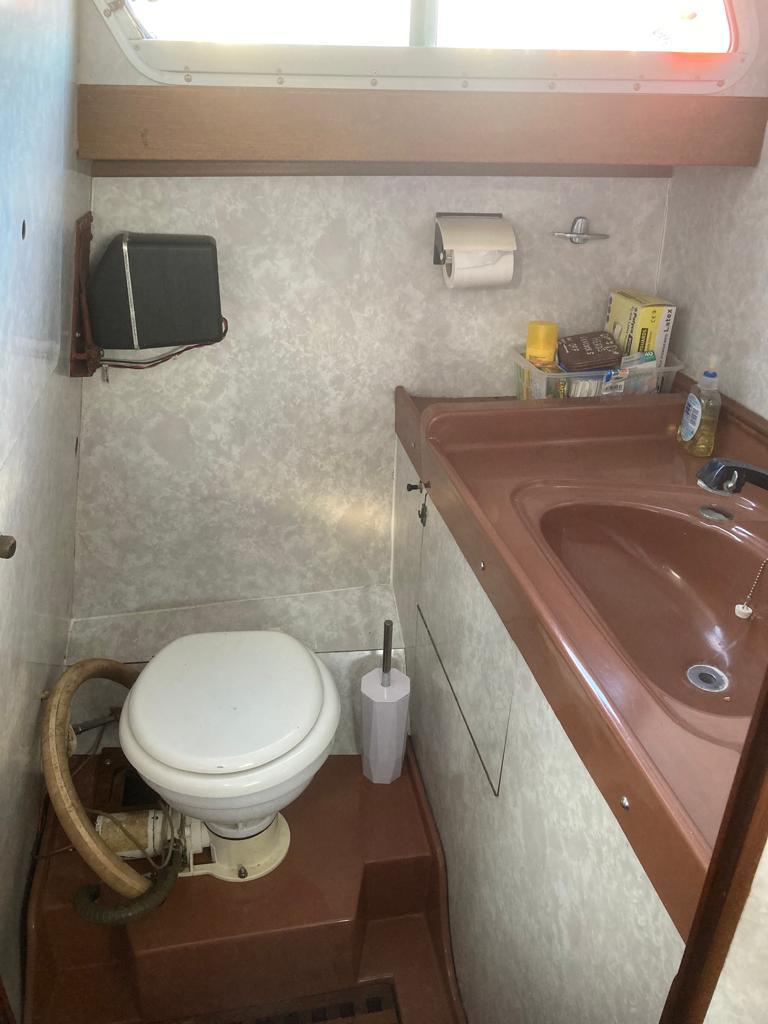
Opposite the Galley are ” the heads” /bathroom. – a shower, electric toilet, wash basin, pressurised hot and cold water , a lift out shower hose. Teak grating allows drainage to sump. Opening window to side deck. Paper towel dispenser.
Going Aft two steps lead up into main saloon.
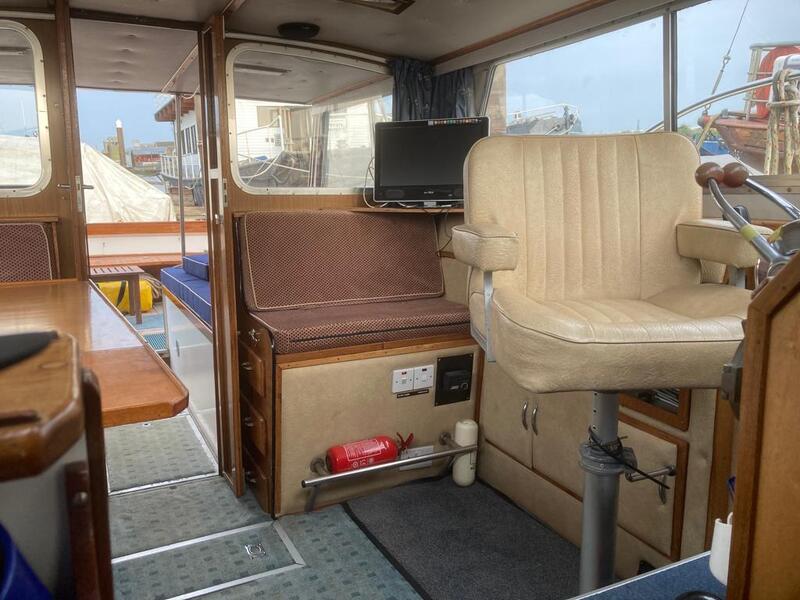
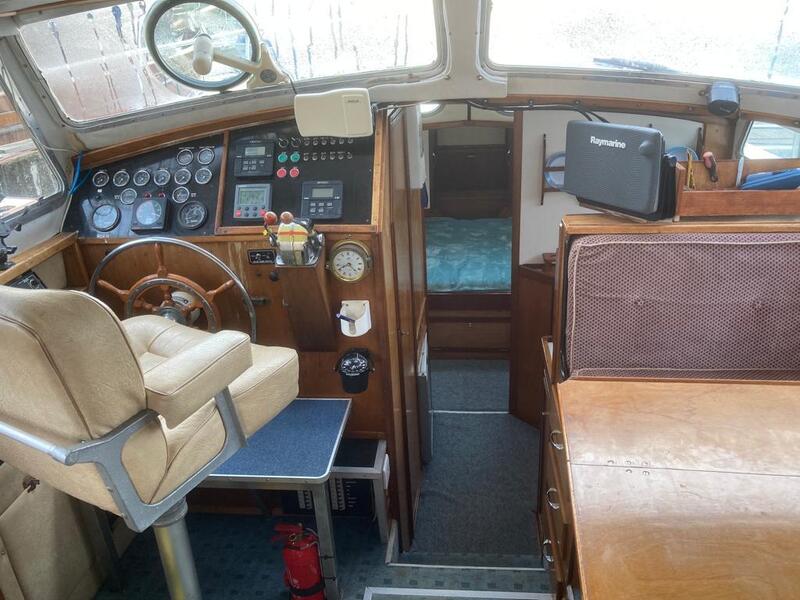
To Port – a swivel helmsman seat with a two- level foot rest. A radio c/d player & speakers. T.V in aft corner. A upholstered seat behind the helm seat with stowage under.( 4 Drawers).
Webasto diesel fired hot air system. Two large hatches in the Saloon floor ( one has the tops for the fuel tanks, the other is used for stowage)
Saloon Starboard – “D” shaped settee surrounds a table with drop leaf (when lowered this makes a wide single berth).
Stowage bins under settee including further drawer stowage. LED overhead flush lighting in head linings.
Entire galley/saloon area is carpeted. Double glazed lockable doors lead aft from saloon to engine bay and external cockpit.
Opposing engine bays have fitted with canvas covered mattresses, makes two large single berths/ sun loungers under the shelter decking. (or with an insert and extra cushions makes into a very large double bed).
When Tonneau cover is fitted on it transforms the engine space/aft cockpit into a third cabin/ sleeping space.
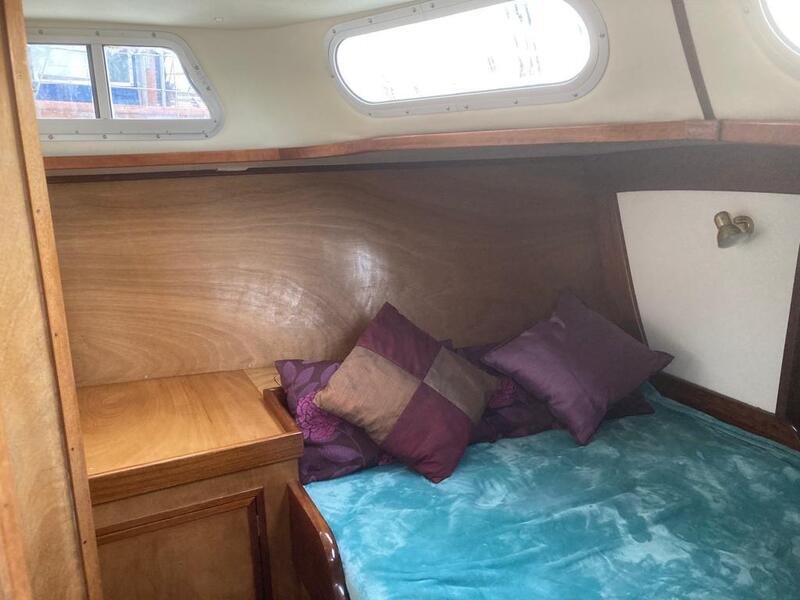
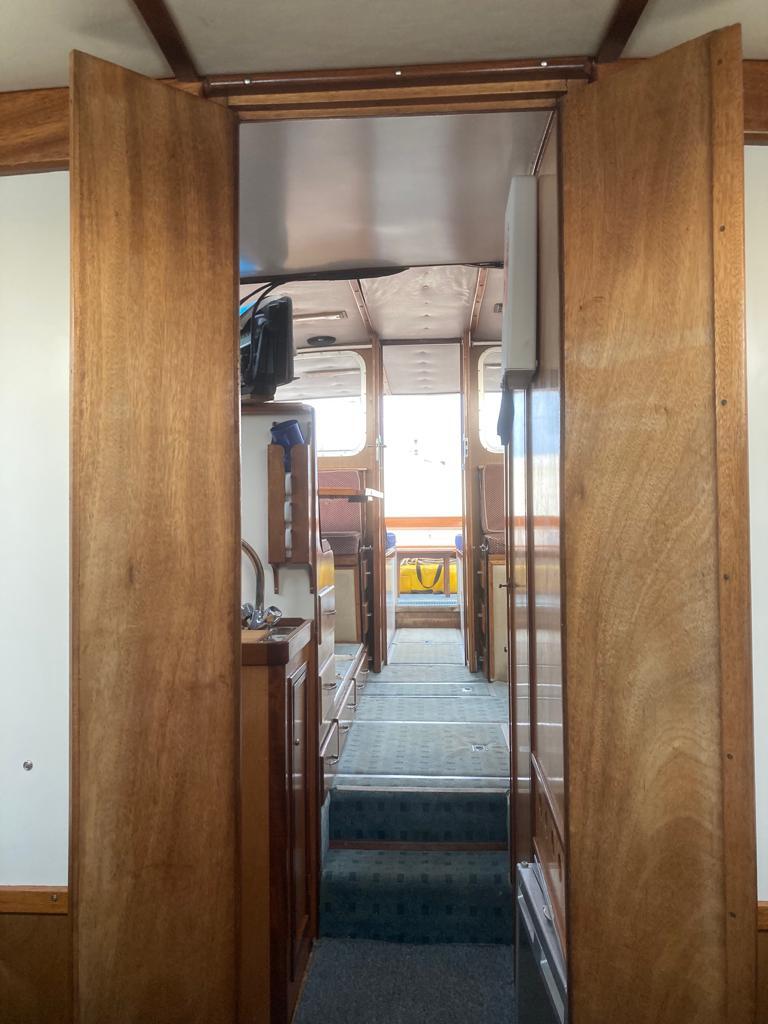
Looking Aft from the fore cabin
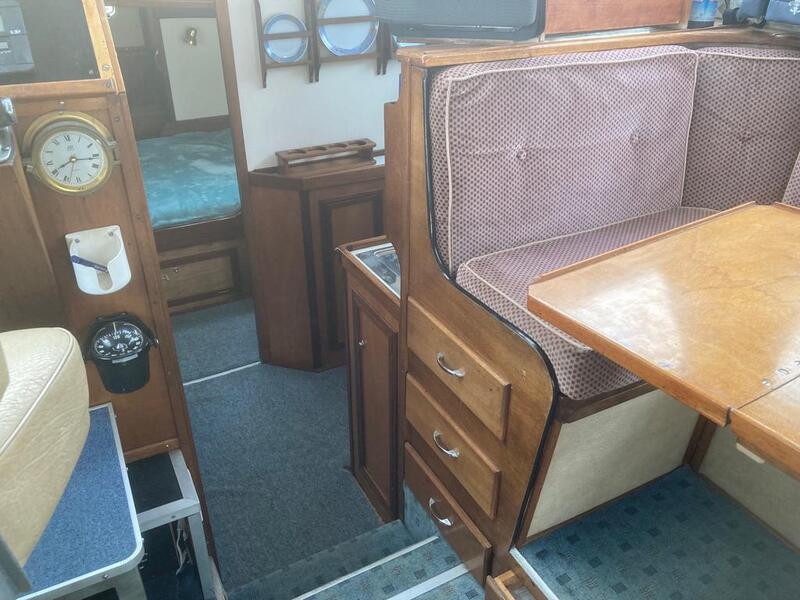
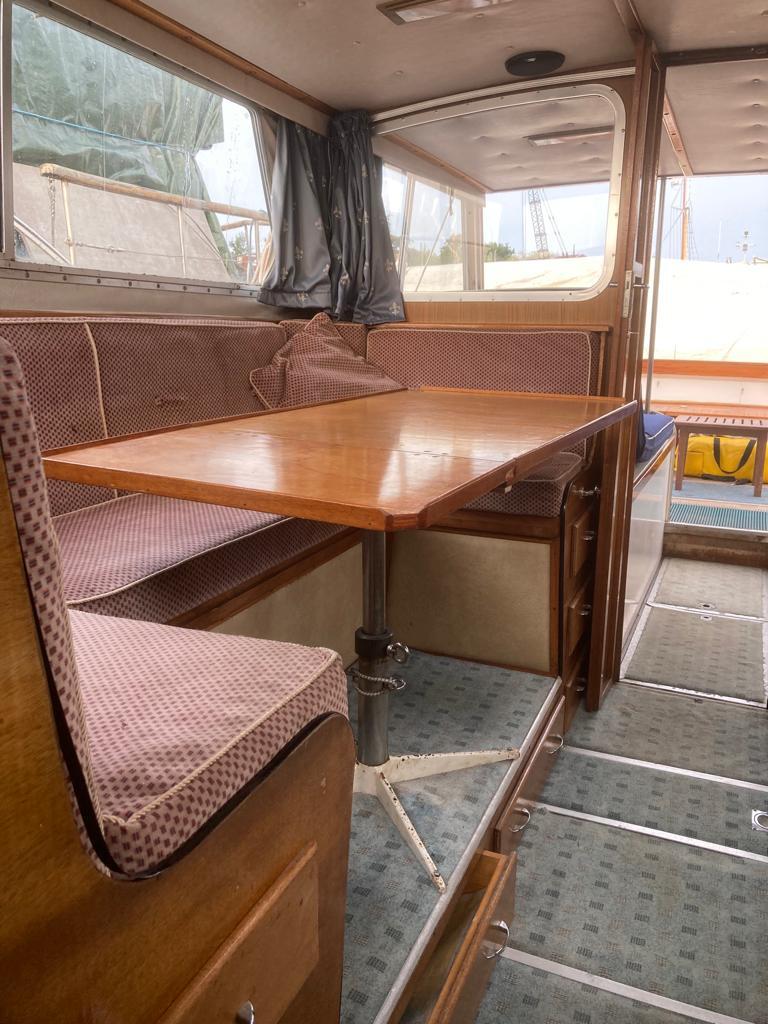
Looking forward from the Saloon Looking aft out to the open cockpit
Equipment:
At the bow a self-draining well, accommodates the electric anchor winch, with remote control and storage for warps, spare kedge anchor and chain.
A main Bruce anchor with 90 feet of calibrated chain, which stores in a drained chain locker.
Substantial cleats are mounted either side of the bow, either side amidships and either side of the stern.
A substantial Tonneau cover with a glazed screen allowing vision aft.
Navigation Equipment:
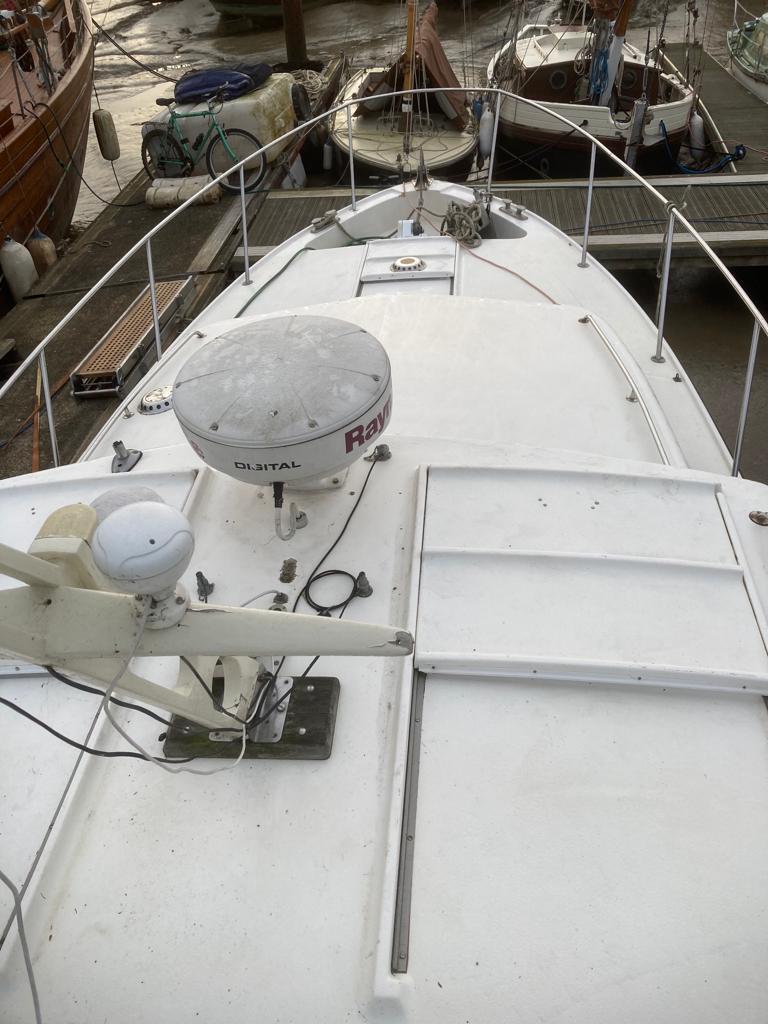
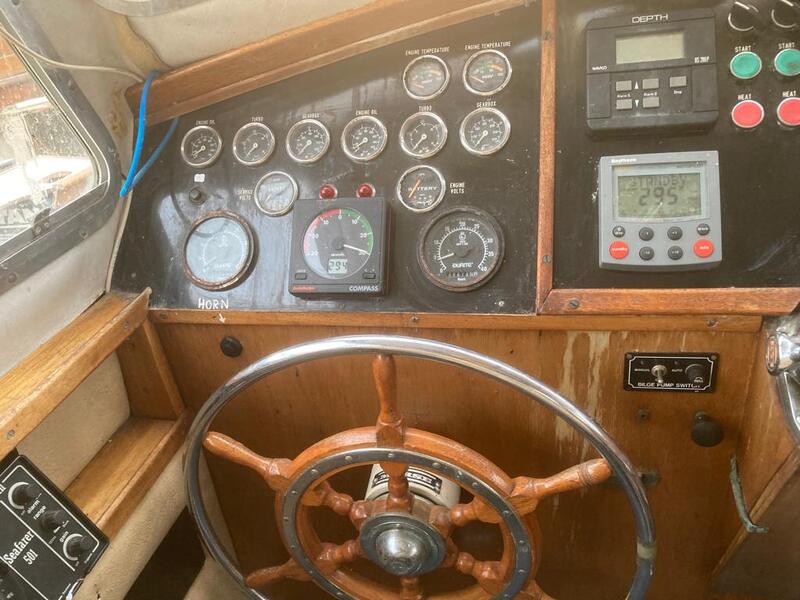
Raymarine Navigating station with display to combine radar and chart plotter
Shelf for nav gear. Wheel steering.
Engine controls and instrument panel
Clock, barometer, stand by magnetic compass.
Main switch panel under footrest
V.H.F Radio to port
Autopilot
CD stereo with speakers in saloon
Compass
Safety Equipment:
Stainless steel guard rails around the bow and for deck
Stainless-steel grab rails along the sides of the saloon coach roof
26″ high Stainless guard rails extends from the bow to halfway along the saloon coach roof.
A gas isolating valve fitted in the galley.
Fire extinguisher.
lifejackets
life raft (needs servicing)
fire extinguishers ( expiry unchecked)
Automatic main bilge pumps, an electric bilge pump situated in the lowest section of the bilge.
2 x horseshoe lifebuoys
Horn
Disclaimer: Disclaimer: The Company offers the details of this vessel in good faith but cannot guarantee or warrant the accuracy of this information nor warrant the condition of the vessel. A buyer should instruct his agents, or his surveyors, to investigate such details as the buyer desires validated. This vessel is offered subject to prior sale, price change, or withdrawal without notice.